

Roma Capitale’s commitment to reducing CO2 emissions that are the cause of climate change is being pursued with plans and actions that see strong collaboration with cities in Europe and around the world.
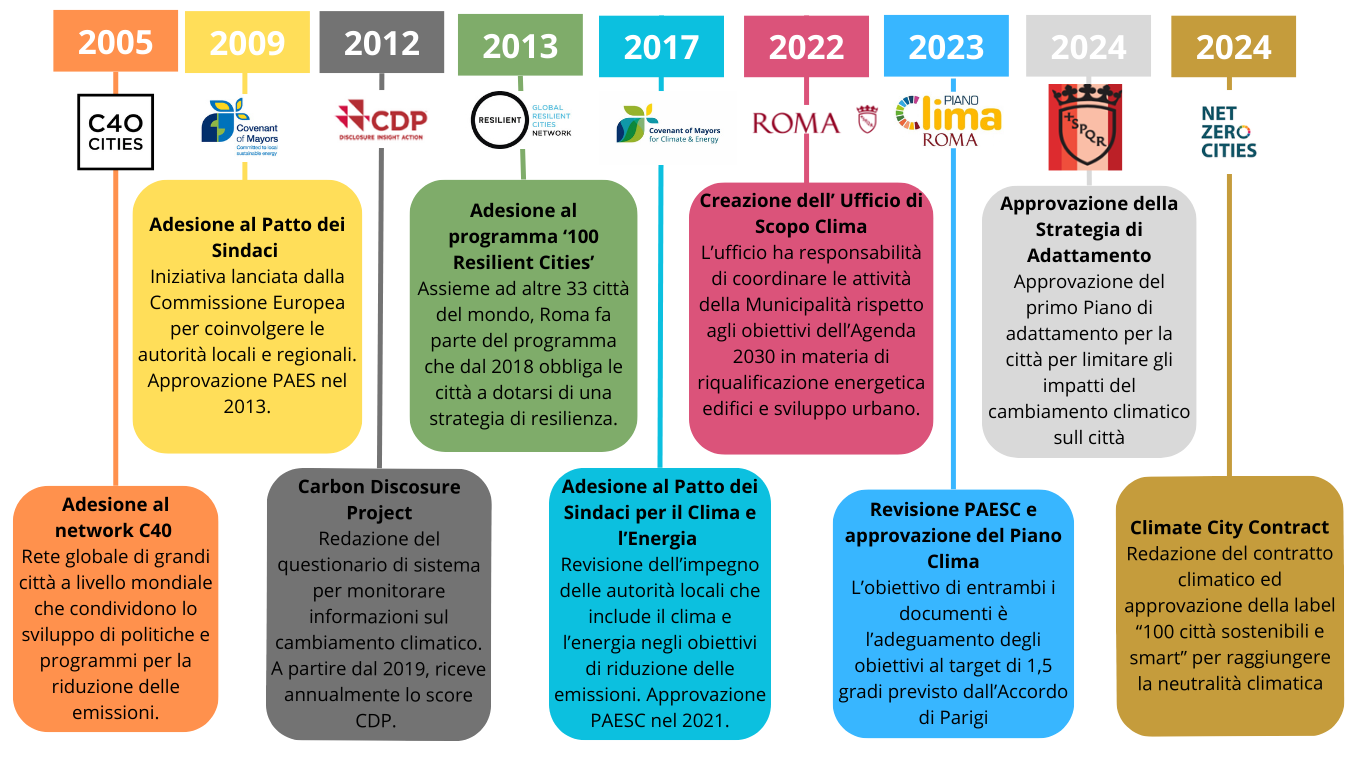
The municipality joined in 2005 the C40 network of the world’s major cities that share a desire to accelerate action to stop climate change, and in 2009 to the Covenant of Mayors (Covenant of Mayors). In 2013, it approved the Sustainable Energy Action Plan (SEAP). In the same year it joined the “100 Resilient Cities” initiative, and in 2021 it approved the PAESC, the Sustainable Energy and Climate Action Plan.
Updates and future goals
In 2023, Rome approved the update of the PAESC, as called for by the C40 Network to contribute to the goal of keeping global temperature within 1.5 degrees. Indeed, the “Deadline 2020” program has developed targets for different major cities around the world, with different targets depending on economic and geographic parameters. For the city of Rome, the expected targets are higher than the reduction set by the 2021 PAESC. The new Plan, approved in November 2023 by the Capitol Assembly, includes an emissions reduction target of -66% to 2030 compared to 2003, which goes beyond the -51.6% forecast in the approved plan in 2021.
In 2022, Rome was selected by the EU Commission as one of the 100 cities in the Mission “100 carbon-neutral and smart cities by 2030” that aim to advance climate neutrality. To set decarbonization goals, commitments and trajectory, cities must approve a Climate City Contract with a coherent urban policy framework, clear governance and monitoring of results over time, through a process of discussion and sharing with stakeholder involvement.
To accelerate and coordinate the city’s adaptation and mitigation policies , a new “Climate” Scoping Office was created in the Mayor’s Cabinet and an internal working group within the administration to ensure strong involvement and coordination of all departments and aldermen while strengthening the scientific support of national research institutes and universities to the process.