

There are two main configurations of widespread self-consumption in which citizens can participate in order to obtain economic incentives and contribute to the decarbonisation of their city’s consumption:
- Renewable Energy Communities ( Comunità Energetiche Rinnovabili – CER)
- Collective self-consumption groups (Gruppi di autoconsumatori collettivi – AUC)
The CERs
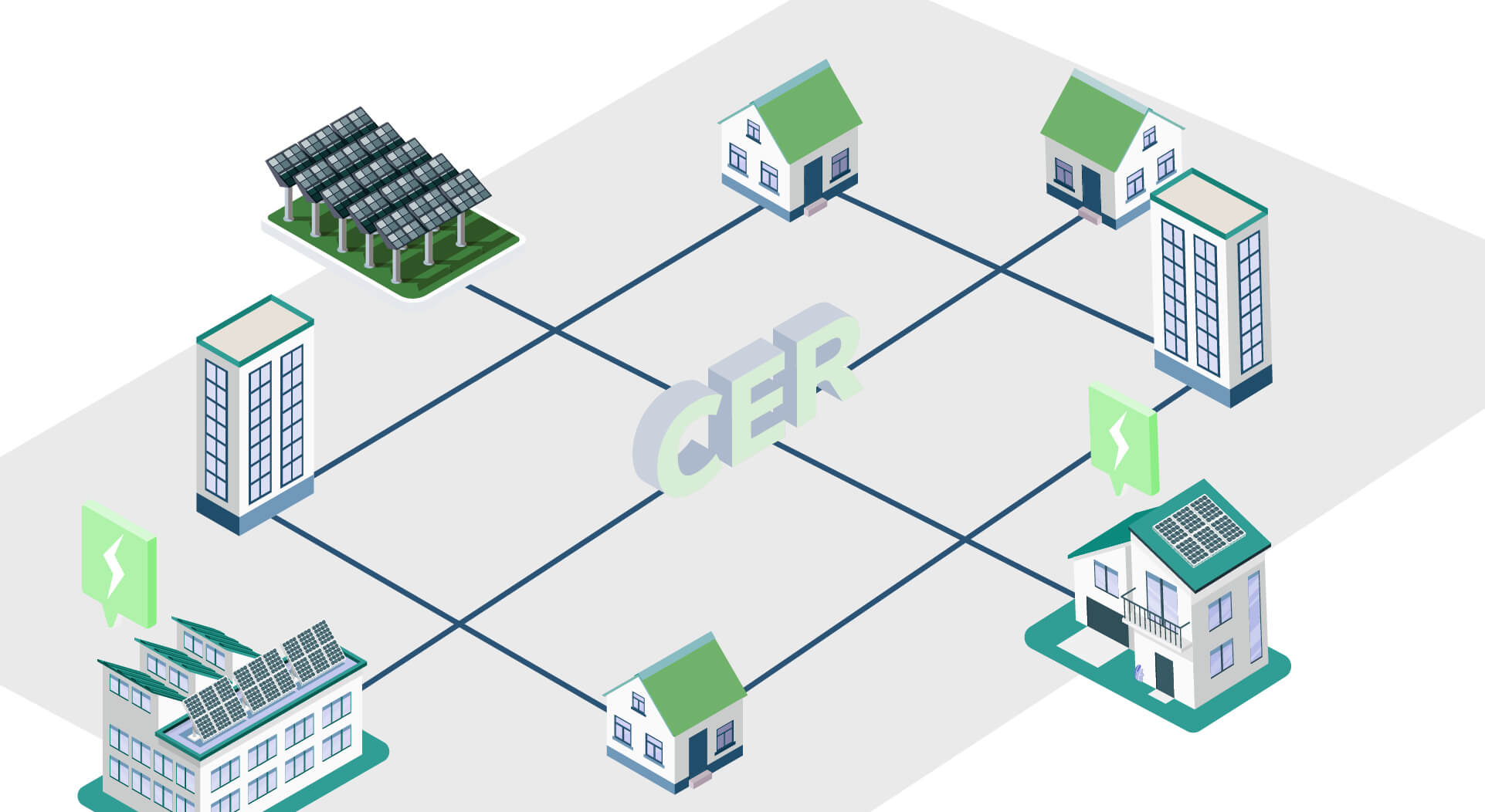
Renewable Energy Communities (CERs) are legal entities that can produce, consume, store, trade and sell energy from one or more renewable plants (e.g. photovoltaic, wind and hydroelectric).
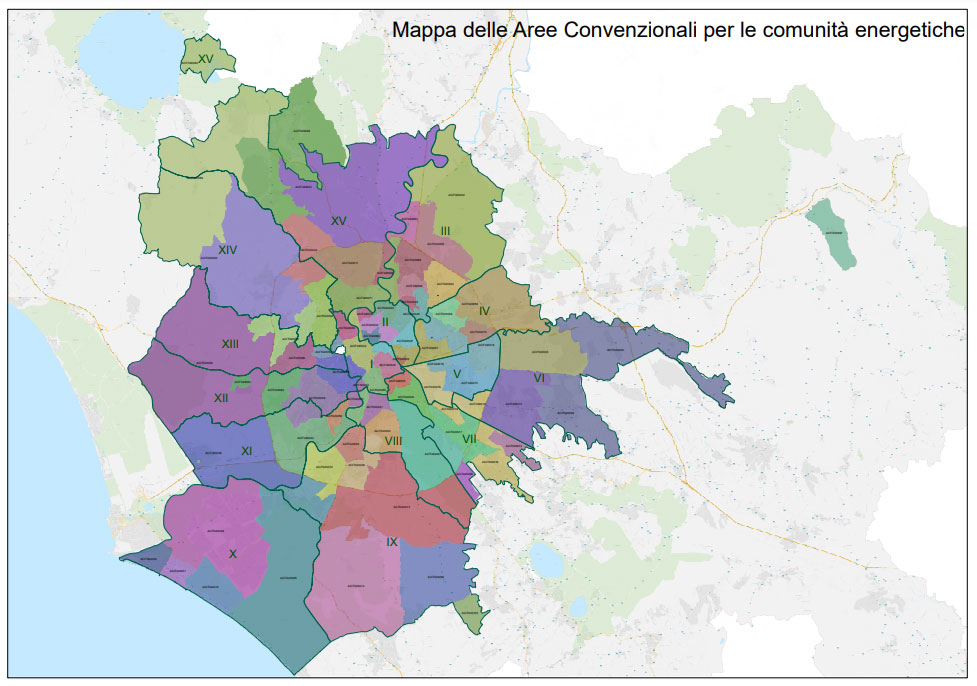
All members of the CER must be connected to the electricity grid via a power meter (POD) and verify that their POD is within the perimeter of the cabin before the CER’s photovoltaic (or other renewable source plant). To check the geographical perimeters of primary substations in Italy, you can consult the interactive map on the GSE website.
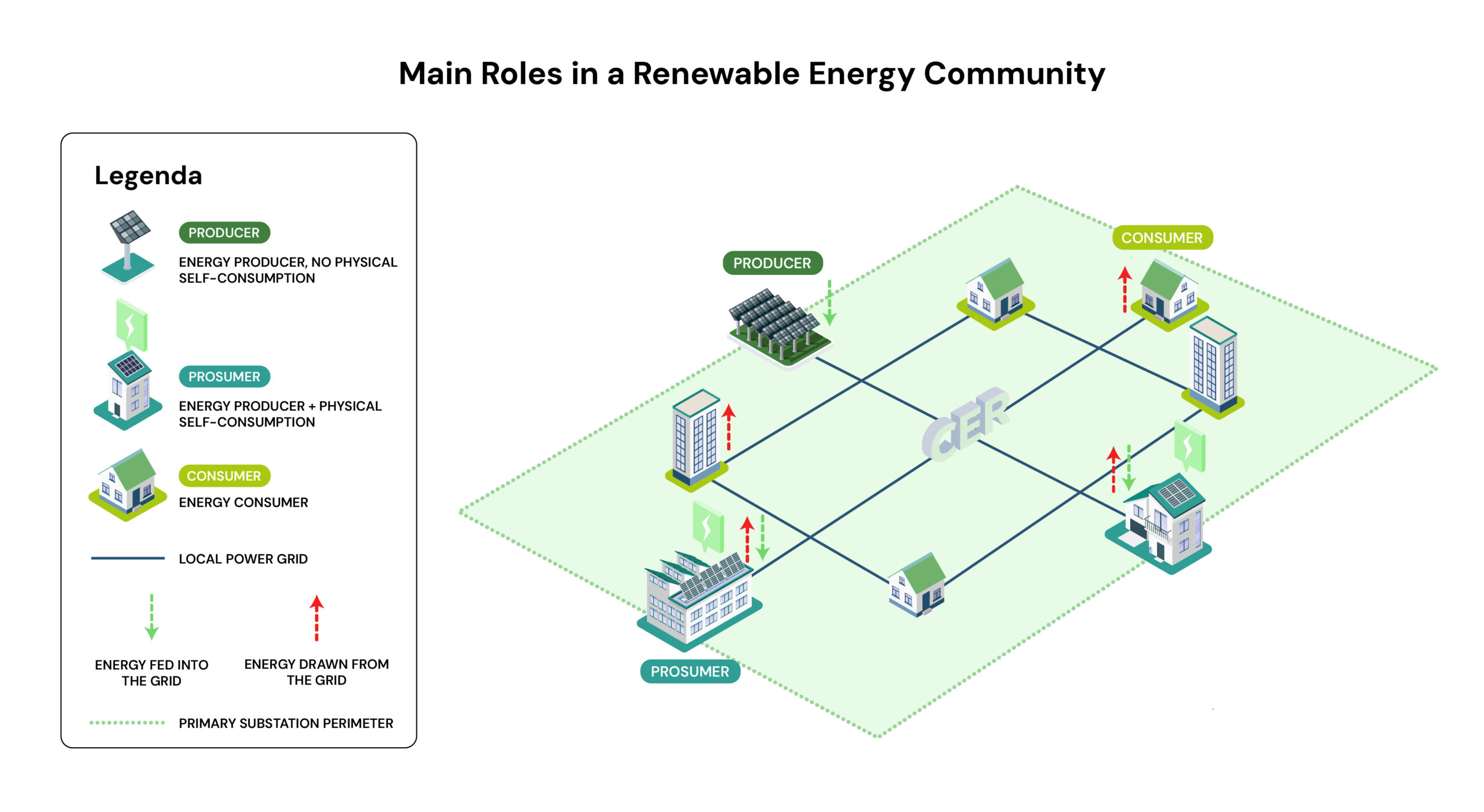
To be part of an energy community, it is not necessary to own a plant: you can join either as a producer member or as a consumer member only.
By law, CERs are not profit-oriented but aim to provide social, economic and environmental benefits for their members and for the area in which they operate.
Italian legislation provides for RECs incentives for diffuse self-consumption (i.e. for renewable energy that can be shared among members) in two different forms: the premium tariff for diffuse self-consumption recognised by the GSE and the ARERA fee for the use of locally produced energy.. In both cases, the incentive is generated when CER members consume the electricity at the time the plant is producing it and feeding it into the grid.
Thanks to the incentives, the CER will be able to accumulate a treasury, which it will be able to redistribute partly among its members and partly use in social projects with a positive impact on the region.
The CERSes
Renewable and Solidarity Energy Communities (CERS) are still Renewable Energy Communities with the addition of the Solidarity component.
In Rome and Lazio, some of these CERS have come together in a regional coordination to promote their Renewable Energy Community model, which envisages the reinvestment of a large part of CER proceeds in community social projects, including support to families in financial distress or the redevelopment of common goods and public spaces.
Moreover, the model of the Rome and Lazio CERS Coordination includes:
- Social inclusion: CERS take in people from different socio-economic backgrounds and collaborate with schools, cooperatives and other local entities, establishing solidarity networks;
- Participatory governance: decisions are taken through the involvement and participation of all the members and, if possible, of the inhabitants of the target area;
- Responsible consumption: educate members on sustainable practices, such as energy saving, shared mobility and adopting low environmental impact lifestyles;
- Fair access to energy: they are committed to ensuring that no one is excluded from access to energy by actively combating energy poverty.
For further information on the Coordination of Renewable and Solidarity Energy Communities of Rome and Lazio or to receive further general information.
The AUCs
Another configuration, which could play a major role particularly in urban areas is the Collective Self-Consumption Groups (Gruppi di Autoconsumo Collettivo , AUC). In this case, the utilities that want to join the AUC must be in the same building or apartment block, sharing energy from one or more installations located in the building or apartment block or other sites available to the collective self-consumption group.
Main differences between CER and AUC
The main aspects of Renewable Energy Communities (RECs) and Collective Self-Consumption Groups (AUCs) according to the Implementation Decrees (Ministerial Decree 414 of 07 Dec. 2023).
-
PerimeterAT/MT primary cabin
-
Single plant power1000 kWp
-
Eligible installationsInstallations put into operation after the establishment of the CERInstallations put into operation on M.D. 414
-
Eligible subjectsHouseholds, SMEs, EELLs, ETS, religious or research organisationsUsers in the same building or block of flats
-
Deliverable servicesIn addition: energy sales, home automation, energy efficiency, EV charging, flexibility/
-
IncentivesBased on plant power, PZO and geographical area
How a CER works
Preconditions
Let ‘s try to understand how an CER works in practice.
The first step is to choose the size of the photovoltaic system to be installed on a private or public building and to determine whether this system should be connected to the POD (Point Of Delivery, i.e. the alphanumeric code assigned to the physical point from which energy is withdrawn from the grid, the meter) of an already active utility on the property above which the system will be installed.
For example, to obtain 20 kW of electrical power, approximately 100 square metres of photovoltaic panels would be needed, which, if placed on a flat roof, might need a total of 200 square metres of roof considering the shadows of the panels themselves, parapets and other possible obstacles that would lead to the system not working efficiently.
Let ‘s see what happens if you choose to connect the energy production plant to an already active POD and, therefore, to a utility that already draws energy from the grid for the needs of the home (or school, or office, etc.).
Creating renewable energy and feeding it into the electrical grid
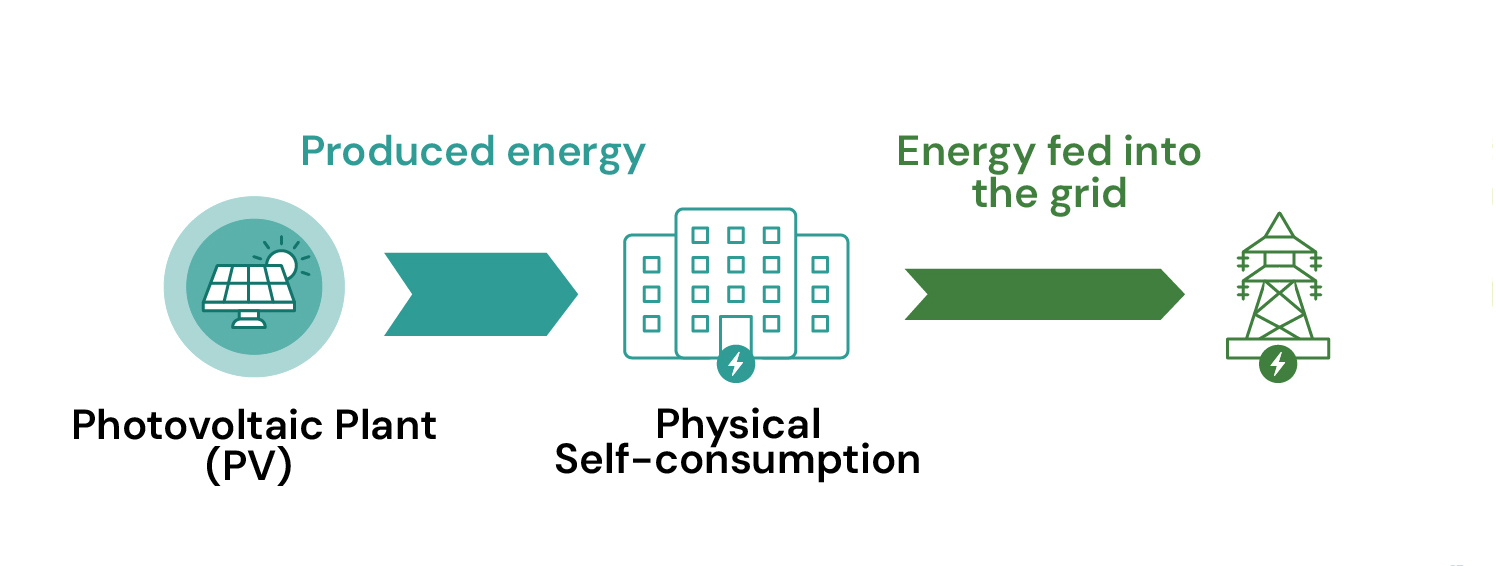
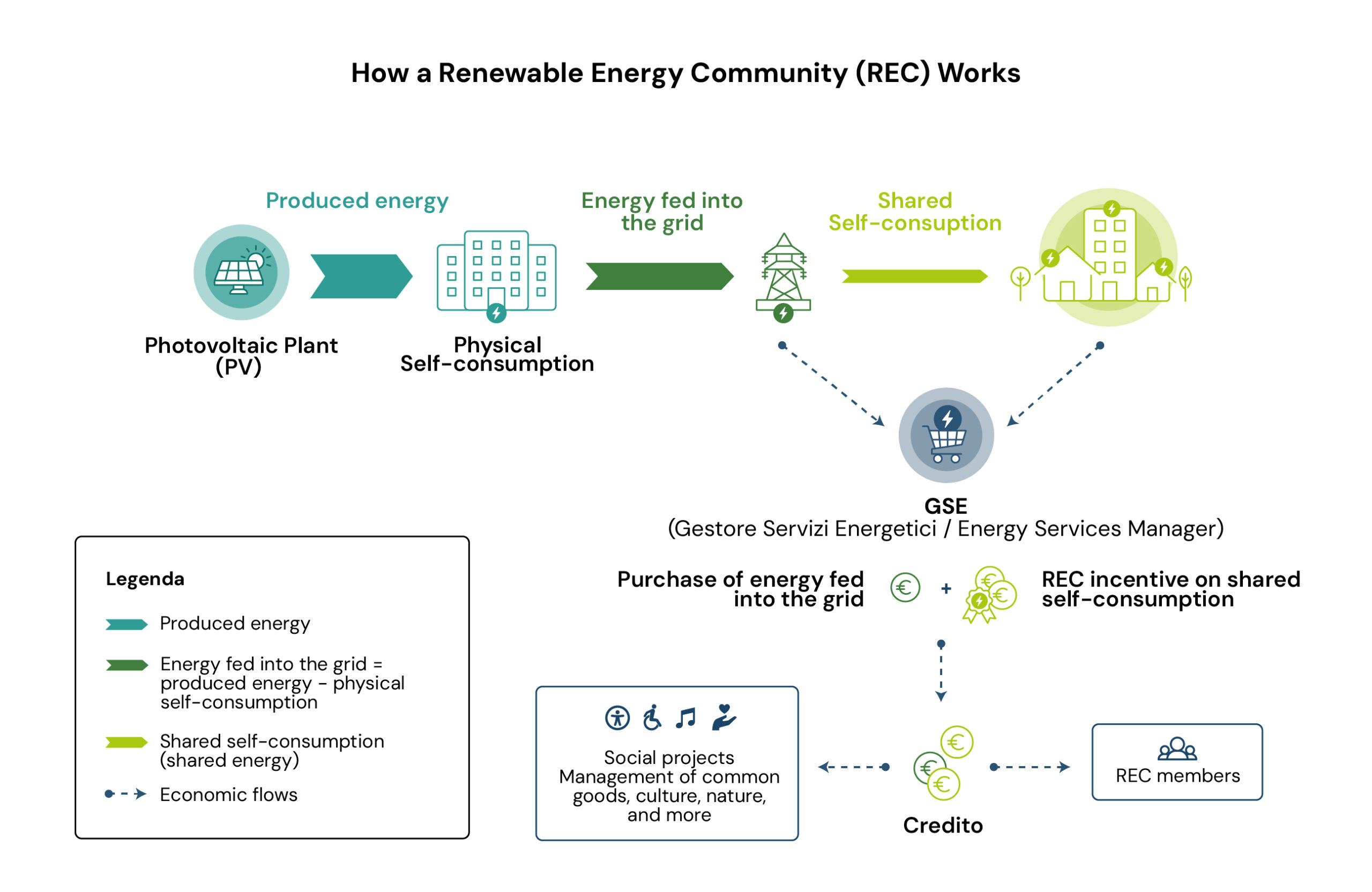
Electricity is generated by all the photovoltaic modules that make up the system, creating what by definition we will call (renewable) energy produced.
All the energy produced is routed via electrical cables to inverters that transform this electrical energy into alternating current suitable for use in various cases.
In fact, the renewable energy produced by the photovoltaic system will be primarily used to power the electrical equipment of homes/schools/offices (lights, appliances, heat pumps, refrigerator, etc.) housed in the same building as the system. This energy used for the direct needs of the building is called Physically Self-consumed Energy (or also Physical Self-consumption).
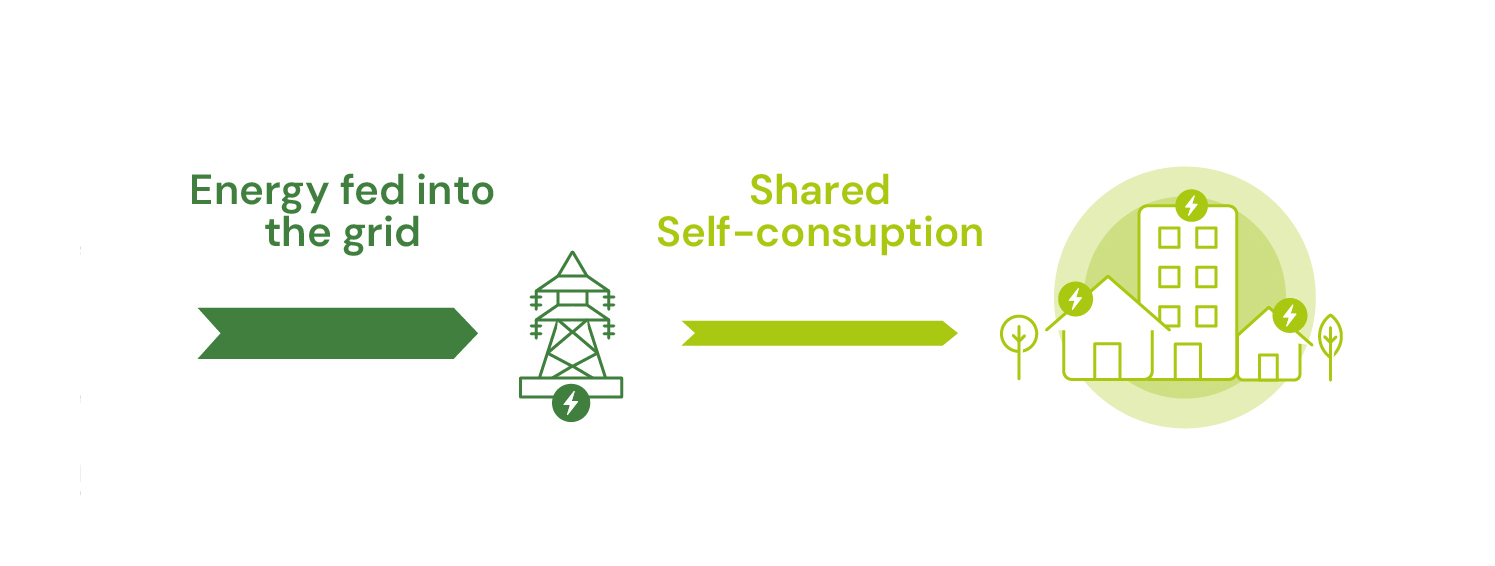
The energy produced by the plant that is left over after being used for the needs of the utility connected to the plant (i.e. that which is left over from the physical self-consumption), will pass into the meter and feed into the electricity grid, via the cables connecting the utility to the grid itself. This energy is called Energy fed into the grid.
The role of individual CER consumers
At this point, only the energy fed into the grid can be made available to the Renewable Energy Community, but only to the users that are within the perimeter of the area’s primary cabin (in Rome, a primary cabin serves an average of 70,000 users).
Citizens who decide to join an Energy Community become partners or members of the CER.
The energy withdrawn by the members is always taken from the grid, it is not directly withdrawn from the plant, but “virtually” it is considered as if the consumers of the CER members were connected to the plant, since (always hypothetically) at that very moment it is feeding energy into the grid. The diffuse self-consumption, for simplicity’s sake also known as Shared Energy, is the energy consumed per hour by all members of the CER and can be at most equal, hour by hour, to the energy fed into the grid by the plant.
The aim of the CER is to make the shared energy as close as possible to 100% of the energy fed into the grid. Keep in mind that a photovoltaic system only produces energy during the day and therefore to maximise the shared energy, CER members should try to take energy from the grid during daylight hours.
The energy fed into the grid by the plant and which is not shared by the CER continues its journey in the power grid.
The economic gain for the community
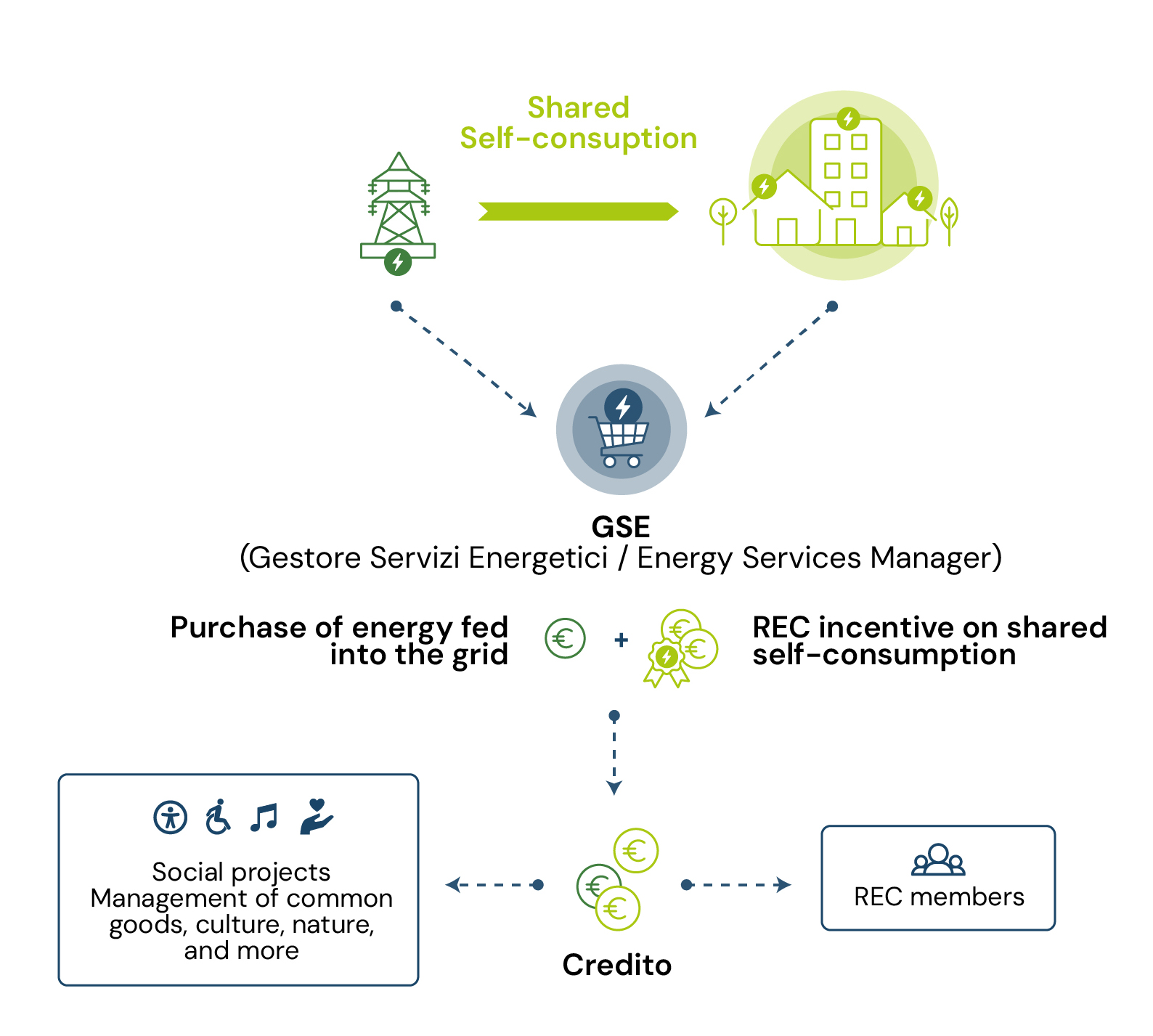
The contact person of the CER shall notify the GSE (Gestore dei Servizi Energetici – www.gse.it) of the names and POD code of the electricity counter of each CER member.
The GSE, having this data, will collect information on the amount of electricity each member withdraws (consumes) from the grid in each hour of the year. The sum of this consumption represents the energy withdrawn collectively by the members of the CER.
The GSE compares this energy with the energy fed into the grid by the photovoltaic plant in order to understand hour by hour how much of the energy fed into the grid by the plant is withdrawn by CER members.
Finally, the GSE pays the legal entity CER a progressively higher economic amount the higher the self-consumption spread. If the CER is also the owner of the plant, the CER may also receive the economic benefit for the sale of the energy fed into the grid. It should be made clear that all energy fed into the grid, regardless of how much of this energy is shared by CER members, can be sold. These amounts will be collected by the CER as a fund to be reused to repay the plant or for projects intended for the community of the members and the neighbourhood, such as cultural initiatives, urban development and decorum, or even as a social cushion.
How a CER works - infographic
Why it 's worth joining a CER
Example of energy and economic flows of a CER
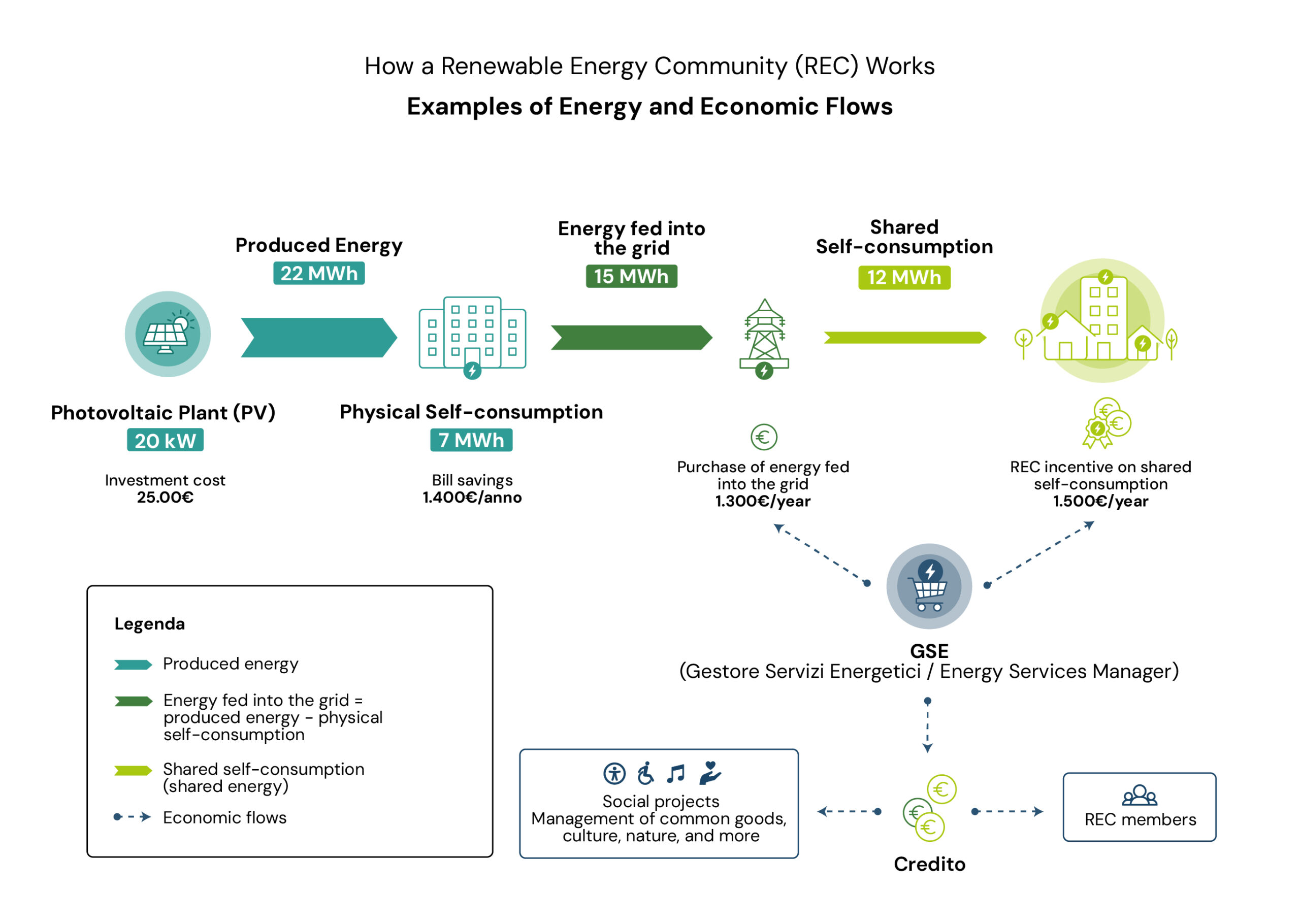
Let ‘s see, in relation to the energy flows analysed above, what economic return we can expect as plant owners, prosumers, and as an Energy Community.
Make money from what you produce and how much more you consume
The energy produced does not currently benefit from any incentive or other economic valuation. Until a few years ago, there were incentives (e.g. Conto Energia) that remunerated all energy produced regardless of its use. These incentives have now been eliminated in favour of incentives that reward the more the energy produced is used (especially if it is renewable) and not just production for its own sake.
Renewable energy helps you save directly on your bill
Physically self-consumed energy is the amount of energy we use to power the equipment in our home. Instead of taking this energy from the grid (with the associated costs on the bill), we take it from the photovoltaic system connected to our utility (via the meter). This will then allow us to save the amount of energy we physically self-consume on our bills.
It should be noted that, for the energy that is physically self-consumed (i.e. not taken from the grid but from the plant), system charges and taxes will also be discounted in the bill.
Let’s take an example: let’s assume a household that consumes around 2,000 kWh/year of electricity each year. If half of this consumption were taken from the photovoltaic system, this would be equivalent to saving 1,000 kWh/year (= 1 MWh/year).
At current energy prices of around 100 €/MWh (= 0.10 €/kWh) and taking into account avoided charges and taxes (around 50% of the bill), the physical self-consumption of this example results in savings of 200 €/year.
This direct bill saving only applies to the utility connected to the system.
Producing renewable energy can be a worthwhile investment
The energy fed into the grid is energy that the owner of the photovoltaic system can sell freely on the market. The GSE is, by law, obliged to buy this energy at the price formed day by day on the energy market.
In order to sell energy to the GSE, one must sign the standard agreement form prepared by the GSE and available on the GSE website.
The owner of the plant, i.e. the producer, may also decide to sell the energy fed into the grid to another authorised party (electricity supply company) with whom an agreement must be reached on the selling price.
However, the economic counter-value (value obtained from the sale) of the energy fed into the grid is accrued by the plant owner.
To get an idea of the economic value of this energy, one can consider that a 20 kW system can produce around 24 MWh/year, and assuming that this energy is all fed into the grid, it will all be purchased at the energy market price, which currently hovers around 100 €/MWh.
Thus 24 MWh will correspond to 2,400 €/year.
Consuming renewable energy for the economic development of your neighbourhood
Diffuse self-consumption is a concept introduced by European directives for CERs and all other similar configurations envisaged (collective self-consumption groups, individual remote self-consumption, citizen energy communities, etc.).
In Italy it can be economically enhanced by taking advantage of the so-called Tariffa Incentivante Premio (Premium Incentive Tariff – TIP) or more simply the CER incentive.
A CER or a Collective Self-Consumption Group will receive a remuneration in euro for each kWh of shared energy (diffuse self-consumption), according to Ministerial Decree 414/23.
For a 20 kW plant in Rome, assuming that all the energy produced (= 24 MWh) is fed into the grid and that the CER is able to share 75% of it (=18 MWh), and assuming that the incentive is 120 €/MWh to be multiplied by the share of self-consumption spread (for 18 MWh), the entire energy community will benefit from 2,160 €/year.
Remember that this money will then be used for various development and support projects for both the CER members themselves and the neighbourhood community, creating not only monetary value but also human and social value.
Comparative tables to better understand consumption
The values given are approximate estimates.
-
Domestic photovoltaic systemPower (kW)3 kW10-15 m2
-
Domestic meter power availablePower (kW)3.3 kW--
-
Photovoltaic system on school buildingPower (kW)50 kW250-500 m2
-
Available power school meterPower (kW)16-50 kW--
-
Photovoltaic system on industrial hallPower (kW)500 kW2,500-5,000 m2
-
Available power industrial meterPower (kW)200-1,000 kW--
-
Photovoltaic plant on landPower (kW)1000 kW (=1 MW)10,000 m2 (one hectare)
-
Standard household consumption in ItalyEnergy (kWh)2,000-3,000 kWh/year
-
Energy produced by domestic PV systemEnergy (kWh)3,000-4,500 kWh/year
-
Incentive for widespread self-consumptionEnergy (kWh / 1,000 kWh = 1 MWh)0.12 €/kWh (= 120 €/kWh)
How to build a CER
Setting up an CER involves several steps, the most important of which is to build a community that shares the same intentions and objectives. To do this, it will be useful to carry out a feasibility study that can show the energy and economic flows that the CER could generate. This will help involve other people or organisations in participating in the project. It will then be necessary to decide, with the help of qualified persons, which legal form best suits the objectives of the CER. Last but not least, it will be important to find funding and land for the construction of the production facilities.
Once the CER has been set up and the plants have been built, this information must be communicated to the GSE (Gestore dei Servizi Energetici), which, after verifying compliance with the technical and regulatory requirements, will disburse the envisaged incentive.
The incentive is paid out for 20 years, so it will need to be managed in the most appropriate way to ensure a long life.
We summarise the main steps to create a CER.
Stages of creating an CER (in brief)
Social-technical feasibility study
Involvement of the territory / membership campaign / data analysis
Legal advice/ CER establishment
Photovoltaic system connection
Training of stakeholders